
Rethinking Infrastructure: Why Spun Concrete Outperforms Galvanized Steel on Sustainability
In the era of sustainable urban development and tightening environmental, social, and governance (ESG) compliance, modern infrastructure developers face a critical question: How do we build long-lasting utility networks while minimizing our carbon footprint? For decades, hot-dip galvanized steel poles have been perceived as a premium choice for utility grids and telecommunications networks. However, a common industry myth persists that concrete is inherently bad for the environment and that steel is the greener alternative.
When you evaluate both materials across their entire lifecycles—from raw material extraction and chemical processing to long-term deployment—the facts reveal a completely different story. Pre-stressed spun concrete poles emerge as the truer, highly superior eco-friendly solution for modern infrastructure.
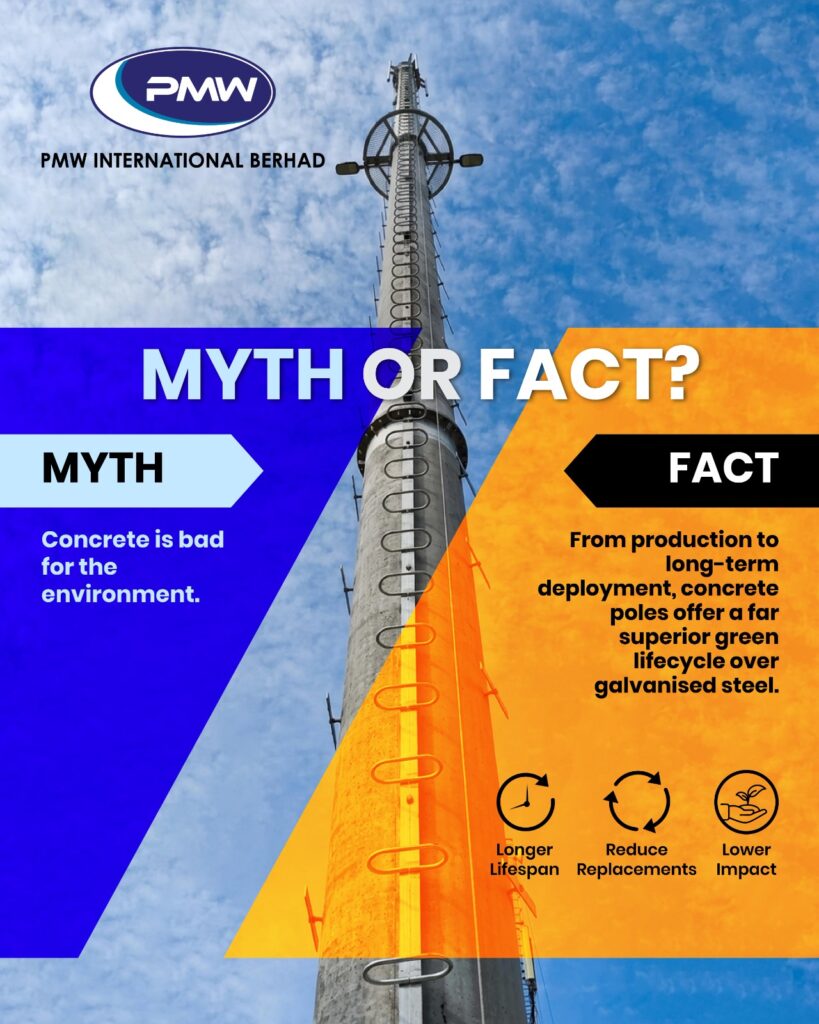
Here is how the two materials stack up.
- The Carbon Footprint of Production: Smelting vs. Centrifugal Spinning
The Steel Process: Producing steel is one of the most energy- and carbon-intensive industrial processes in the world. Extracting iron ore and melting it requires coal-fired blast furnaces operating at extreme temperatures. Furthermore, to protect steel from rust, it must undergo hot-dip galvanizing. This secondary process involves dipping the steel into molten zinc, adding another significant layer of energy consumption, high carbon emissions, and heavy industrial waste.
The Spun Concrete Solution: While cement manufacturing does emit $\text{CO}_2$, the energy required to manufacture a concrete pole is substantially lower than smelting steel. Furthermore, industrial engineering methods—specifically pre-stressed spun concrete—utilize centrifugal force to pack the concrete mix tightly. This achieves maximum load-bearing capability and structural strength using a significantly lower volume of raw materials than traditional cast concrete methods, drastically reducing resource consumption from the start.
- Materials Adaptability: Driving Carbon-Negative Innovations
The Steel Limitation: Steel production is locked into highly rigid, high-emission chemical and thermal formulas. There is very little flexibility to structurally alter the material to actively capture environmental emissions during its manufacturing stage.
The Concrete Innovation: Concrete is uniquely adaptable to green material science. Today, concrete manufacturing can incorporate advanced eco-additives, most notably Biochar. When biochar is blended into the concrete mix, it permanently traps and sequesters carbon right inside the structure. This turns standard utility or telecom poles into literal “carbon sinks” that lock away greenhouse gases for decades, transforming a traditionally carbon-emitting sector into a vehicle for carbon reduction.
- Longevity, Maintenance, and Chemical Eco-Toxicity
Galvanized Steel Lifespan: Although hot-dip galvanizing protects steel from corrosion, that protective zinc layer is sacrificial and gradually degrades over time. In highly humid, coastal, or industrial areas, galvanized steel poles will eventually rust. Maintenance requires harsh chemical treatments, painting, or premature replacement—all of which multiply the product’s lifetime environmental toll. Additionally, the galvanizing process itself relies on harsh acid baths (pickling), posing strict environmental hazards regarding toxic chemical waste and runoff management.
Spun Concrete Durability: Concrete naturally resists tropical weather, heavy rain, UV radiation, and pests (such as termites) without requiring any artificial chemical coatings. A pre-stressed spun concrete pole easily achieves a lifespan of 50 to 80+ years with virtually zero maintenance. Because it is composed of natural, inert materials (sand, gravel, water, and cement), it will never leach toxic chemicals, acids, or heavy metals into the surrounding soil or groundwater during its decades of service.
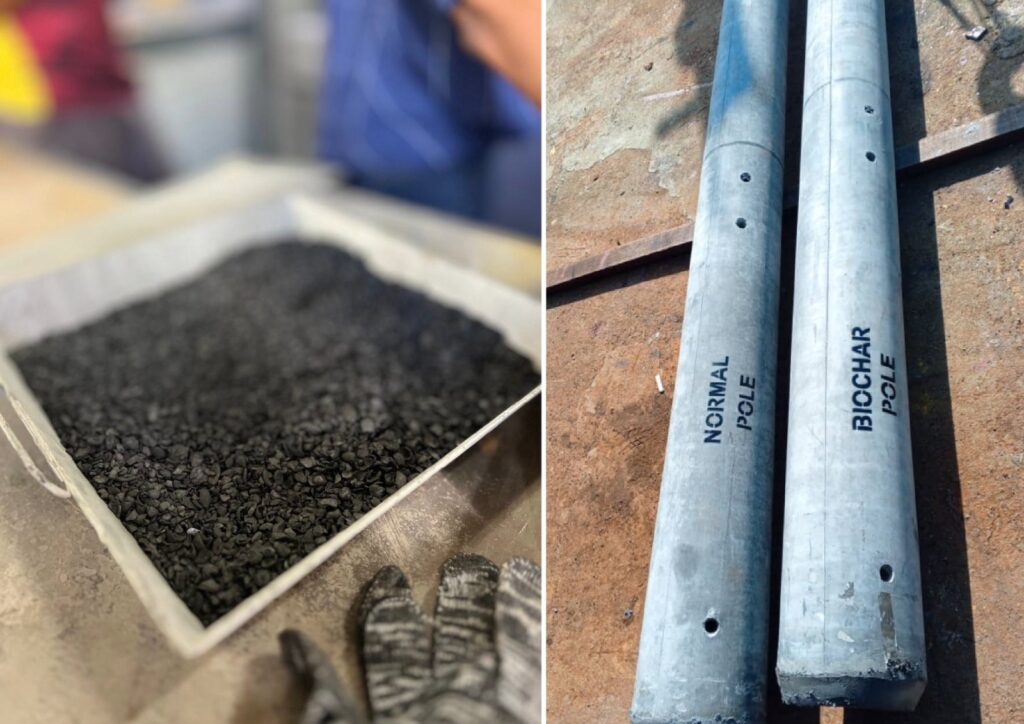
The Fact: Modern Infrastructure Belongs to Smart Concrete
Sustainability in civil engineering isn’t about abandoning the robust foundations of our utility grids; it is about re-engineering them for a greener tomorrow.
While galvanized steel remains widely used, pre-stressed spun concrete provides a cleaner lifecycle, eliminates toxic rust-proofing chemicals, outlasts steel in harsh climates, and actively integrates carbon-capturing tech like biochar. By choosing precision-engineered spun concrete poles, infrastructure managers can successfully align corporate network expansion with global climate goals—proving that strength and sustainability can stand together.